Local and worldwide wildlife adventures. Drone cameraman to TV's Nigel Marven. Dedicated Nikon user. Follow me on Twitter @chardbirder and Instagram: www.instagram.com/chardherper/. All images on this Blog are copyright of the Owner/contributors and cannot be used without written permission. All views expressed are my own. Translation to other languages available at the end of the page.
Day 3, Taman Negara National Park - 26 November 2016
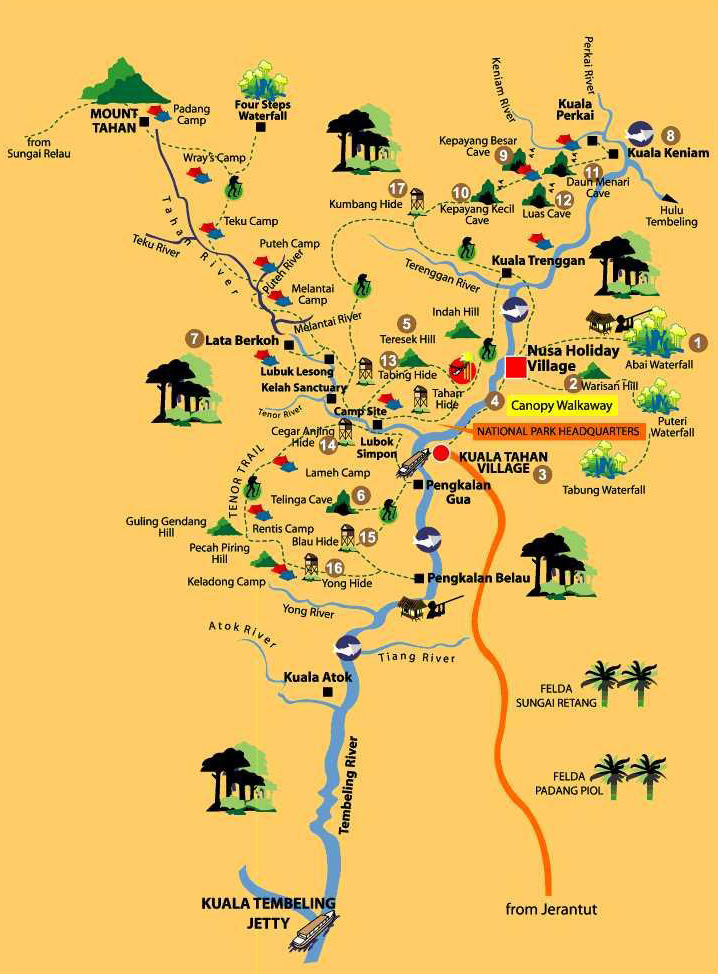
Map showing the area around the Mutiara Resort, Taman Negara
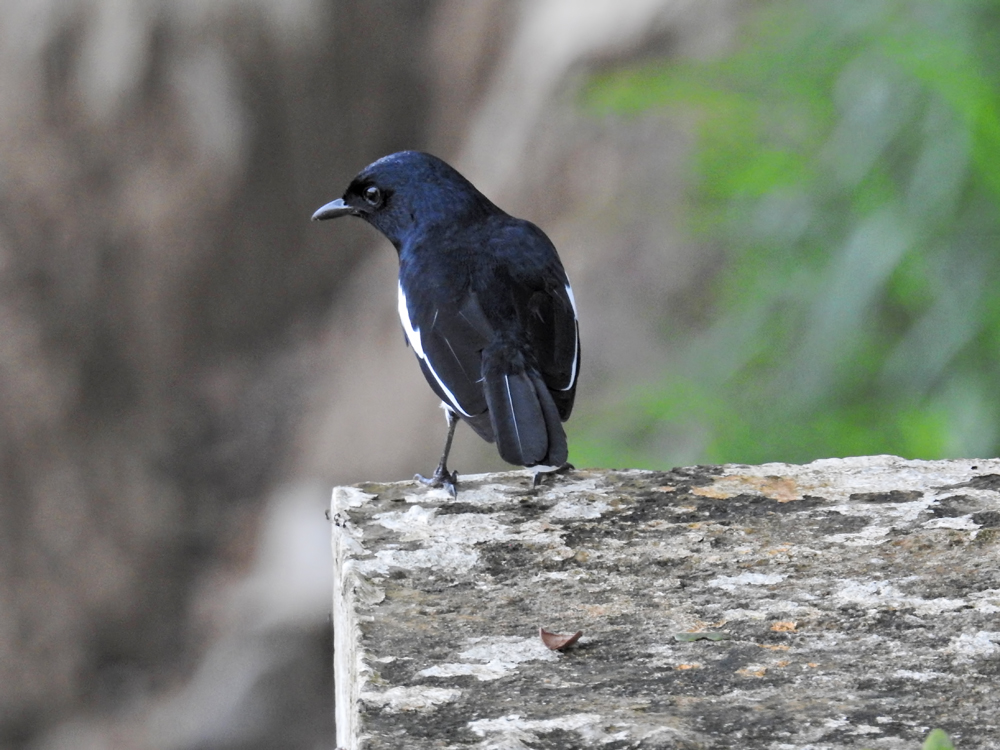
Every morning we were greeted by Oriental Magpie Robins,
easily the commonest bird.
Proper rainforest. The clouds could descend one minute
only to vanish again the next.
Everything near the river floats, even the restaurants.
After an early breakfast we set off south along the Tembeling River by boat to Pengkalan Belau, where we jumped ashore and joined the trail towards the Blau Hide. Before disembarking we had my first new bird of the day in the shape of a lone Black Hornbill, which perched just long enough for a poor photo record.
Brief views of a Black Hornbill - 1st tick of the day!
Having rained heavily the night before the trails were muddy and it wasn't long before the leeches started emerging and our guide Wilbur was the first to find one on his lower leg. My spray had worked and I avoided being a meal - although not harmful the bite site itches and I counted myself lucky to avoid them. We were also extra fortunate to be the only people walking the trail that day as it had been recently closed and access had only been granted to the four of us.
Boat ride along the Tembeling River, Taman Negara
Although the birding was slow to begin with it soon started to pick up with species such as Greater Racket-tailed Drongo, Scarlet-rumped Trogon, Raffles's and Black-bellied Malkoha, Yellow-bellied and Gray-cheeked Bulbul and the amazing Black-and-yellow Broadbill. However the bird we were all after (but didn't expect to see) was the Crested Jay. We had three of these magnificent birds, with there machine gun like calls and huge crests, flying around us and occasionally, though briefly, showing well - unusual for this notoriously difficult species. This wasn't the most difficult bird of the day though - that title goes to the Large Wren Babbler, a very elusive, skulker which took ages to show. All the more satisfying when you've seen it though.
Pair of Yellow-bellied Bulbuls
Greater Coucal
Greater Racquet-tailed Drongo
Difficult terrain to bird in. After a few days of this
you get lots of stiff necks.
Progress is not helped by this - rattan is a constant reminder
that you have to keep your eyes open on the trails or
you get a very nasty surprise.
Around 150ft tall these enormous trunks drive
straight up before leafy branches reach out from
the very tops.
Back at the Mutiara a quick look for the Crested Fireback at the campsite revealed a few Bulbuls and Spiderhunters but no fancy pheasant. This is supposed to be one of the best places to see this rare bird but it's so far eluded us. There were a few nice butterflies drinking from the path though:
Campsite at Mutiara Taman Negara
Fivebar Swordtail
Great Jay
Malayan Baron looking a bit worse for wear
Magpie Crow
In the afternoon we walked from the resort towards Lubok Simpon and added Spectacled and Gray-breasted Spiderhunters to the list along with Stripe-throated Bulbul, Sooty-Capped Babler, House Swift and Black-naped Monarch.
The boardwalk towards Lubok Simpon
A pair of Black and Red Broadbills hiding in the canopy
Lubok Simpon - Blue-banded Kingfisher territory.
Although it looked like a great spot, unfortunately there was still no Blue-banded Kingfisher to be seen. The restaurant that evening at the Mutiara was alive with non-paying guests, including a number of these Flat-tailed Geckos Hemidactylus platyurus.
An early start from the Sama Sama Hotel this morning. We met our bird guide Wilbur Goh and his colleague Azri Mohd Hussain from Junglewalla Tours in the hotel lobby and set off for Taman Negara National Park, a UNESCO World Heritage Site about 5 hours drive to the northeast of Kuala Lumpur. Covering an area of more than 4000 km2. Taman Negara is lowland primary rain forest and is considered to be one of the world's oldest, estimated to have been here for 130 million years!
To reach our target we had to pass around Kuala Lumpur and avoid the morning rush hour (hence the early start). Two hours after skirting the city we made a quick breakfast stop for the best locally made Roti at a small roadside cafe, where Pacific Swallows, Barn Swallows and unidentified swiftlets whizzed around overhead as we ate. From here we moved a short distance to the Krau Wildlife Reserve at Bukit Rengit where the birding began in earnest.
Upon arrival at the toll exit parking point I immediately had more bird ticks - a pair of beautiful Black-thighed Falconets closely followed by Pink-necked Pigeon, Spotted Dove and Oriental Magpie Robin.
The diminutive Black-thighed Falconet - not much bigger than a budgerigar
Black-thighed Falconet
A couple of miles further on we pulled over to the side of the road and added Black-naped Oriole and Crested Goshawk to a rapidly expanding list. A short distance on again we got out to walk a stretch of quiet road known for its good variety of species. It certainly didn't disappoint and we quickly added Blue-throated Bee-eater, Dark-throated Oriole, Crested Serpent Eagle, Purple-naped Spiderhunter, Crimson-winged Woodpecker, Gray-and-Buff Woodpecker, Ferruginous Babbler, Scarlet-rumped Trogon and many more. The highlight though was undoubtedly the appearance of a female Banded Pitta, so bright it's amazing how it manages to stay hidden even at close range!
The habitat around Krau holds a huge variety of species.
Black-naped Oriole: R. Harris
Ferruginous Babbler, a very confiding individual
Ferruginous Babbler: R. Harris
White-rumped Shama - picked up by their noisy calls
Banded Pitta, female - very difficult to photograph as it moved unseen
across the jungle floor. Better binocular views thankfully.
Krau Wildlife Reserve
Red-billed Malkoha
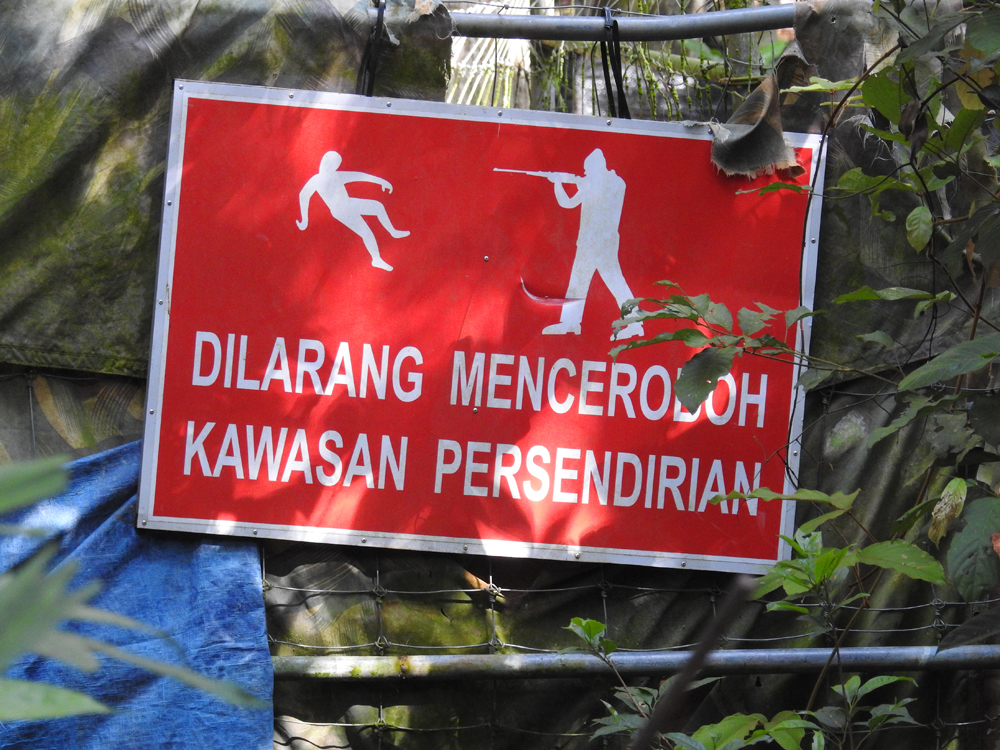
Subtle! This guy doesn't want visitors.
Nigel Marven and bird guide Wilbur Goh at Krau.
The fenced off area is set to hold tigers at some point in the future.
The journey to Taman Negara took another 3 hours. Instead of joining the tourist boat from Jerantut (which adds another 3 hours to the journey), we headed straight for Kuala Tahan by road, which sits opposite the Mutiara Resort across the Tembeling River. The journey was completed by a short river boat transfer but the day was far from over.
View across the Tembeling River from Kuala Tahan
The place to catch the river ferry.
A quick ferry ride and we were at the Mutiara
After settling into our chalets we reconvened to explore the trails close to the resort. Noisy Oriental Magpie Robins were everywhere and Asian Fairy Bluebirds moved between the trees. The Tahan hide and nearby boardwalks produced (among others) a stunning Black-and-red Broadbill, Long-billed Spiderhunter, Raffle's Malkoha, Grey-breasted Bulbul and Scarlet-rumped Trogon. The variety was added to by a troup of Long-tailed Macaques and a lovely Clouded Monitor which wandered through the resort grounds as we returned. What a day!
Inside my chalet - clean and comfortable, it even had air con!
The Tehan Hide, Mutiara Taman Negara
View from the Tahan Hide
Wilbur Goh, bird guide extraordinaire
for Junglewalla Tours
Just off the boardwalks, impenetrable jungle
Asian Fairy Bluebird - much more pretty if seen from above.
Black-and-red Broadbill, one of my favourite birds
Oriental Magpie Robin, female
Oriental Magpie Robin, female
The lowland rainforest is a hot and humid place, you don't stop sweating from the minute you leave your air conditioned room. Once you get your head around the fact that you are just going to be ringing wet with sweat the entire day you soon forget about it and get on with the task in hand. Back at the chalet a Clouded Monitor was scratching around looking for food and getting harassed by Long-tailed Macaques - the first reptile of the trip. Great way to round off a great day.
Welcome to a series of blog posts following my visit to Peninsular Malaysia!
I've just been fortunate enough to accompany tv zoologist, producer, birder and fellow herper, Nigel Marven on a short tour to explore the diverse wildlife of Peninsular (West) Malaysia. Visiting a country that's so ecologically diverse with such esteemed company is a truly awesome experience and a great honour - thanks for the invite Nigel! The posts that follow will cover our week-long trip, starting with one of the oldest rainforests on earth, Taman Negara and finishing on the cooler montane slopes of Bukit Fraser (or Fraser's Hill) to the Northeast of Kuala Lumpur. Both are birding hot-spots and offer a wide variety of other wildlife too.
Malaysia
Malaysia is home to over 700 species of birds (not to mention it's wealth of mammals, plants, insects, reptiles and amphibians), below is a map to outline the area I've been visiting with Nigel. My trip was to Peninsular (West) Malaysia but Malaysia also occupies part of the island of Borneo to the east.
Map of Peninsular Malaysia.
Thailand and Cambodia to the north and Sumatra to the south. It sits in the South China Sea.
The two areas visited in Peninsular
Malaysia - Taman Negara and Fraser's Hill
Day 1: 23/24 November 2016
My journey started with a routine 13-hour flight from London to Kuala Lumpur (KL) with British Airways on one of their new Boeing 787 Dreamliner services, which got me in to KL around 15:50 local time (Malaysia is +8 hours GMT). I transferred to the comfortable surroundings of the Sama Sama Hotel (formerly the Pan Pacific), which is attached to the airport terminal by a glass walkway. I had my first Malaysian bird tick whilst walking through this walkway, a 1st winter Asian Glossy Starling, which appeared to have stunned itself against the glass wall.
1st winter Asian Glossy Starling, Kuala Lumpur. Taken on my smartphone.
It was from the hotel that I met up with Nigel and where we were due to meet our birding guide from Junglewalla Tours the following morning. But for now, it was time to rest and start getting use to the 30° heat and humidity. A bit of late afternoon birding from the window of my room yielded more new birds - a pair of White-throated Kingfishers, Yellow-vented Bulbul, Pacific Swallow and a nice mixed flock of Common and Javan Mynas.
Common Mynas were always a bit distant and not as common as
their Javan cousins.
A very distant White-throated Kingfisher in the hotel garden
just before dusk