Monday, 6 August 2018

The Western Highlands...part 1

Scotland is a beautiful country, there’s no disputing that. Having visited the central Highlands several times, I thought the scenery there was hard to beat, however a family holiday to the west coast has just surpassed it and it’s pretty darn good for wildlife too!

Based beside Loch Long at Dornie, I had easy access to Skye and the western mainland of Ross & Cromaty and Inverness. The mountains are towering and the vistas dramatic, great country for eagles!

Our first stop after flying from Bristol to Inverness was a night at Loch Ness, just to break the journey. I was immediately rewarded with good views of Red-throated Diver.

First stop, Loch Ness.

Harebell

Red-throated Diver, Loch Ness

Grey Wagtail, Loch Ness
The next morning we continued south for a while before turning west towards the coast and our destination, Dornie. This would be our base for the week in a rented three bedroom cottage on the shores of Loch Long. Dornie might be small but it has Eilean Donan Castle, one of the most photographed castles in Europe and you can see why, it’s set in a stunning location!

Eilean Donan Castle, Dornie, Highlands.

Loch Long and Dornie, looking northeast.
The mountains in the distance are home
to Golden Eagles.

Loch Long looking southwest towards Dornie at sunset.

The first birds seen as we drove along the Loch shore to our cottage was a small flock of Greylag geese and a few Hooded Crows.

Greylag Geese, Loch Long.

Hooded Crow picking through the seaweed. 

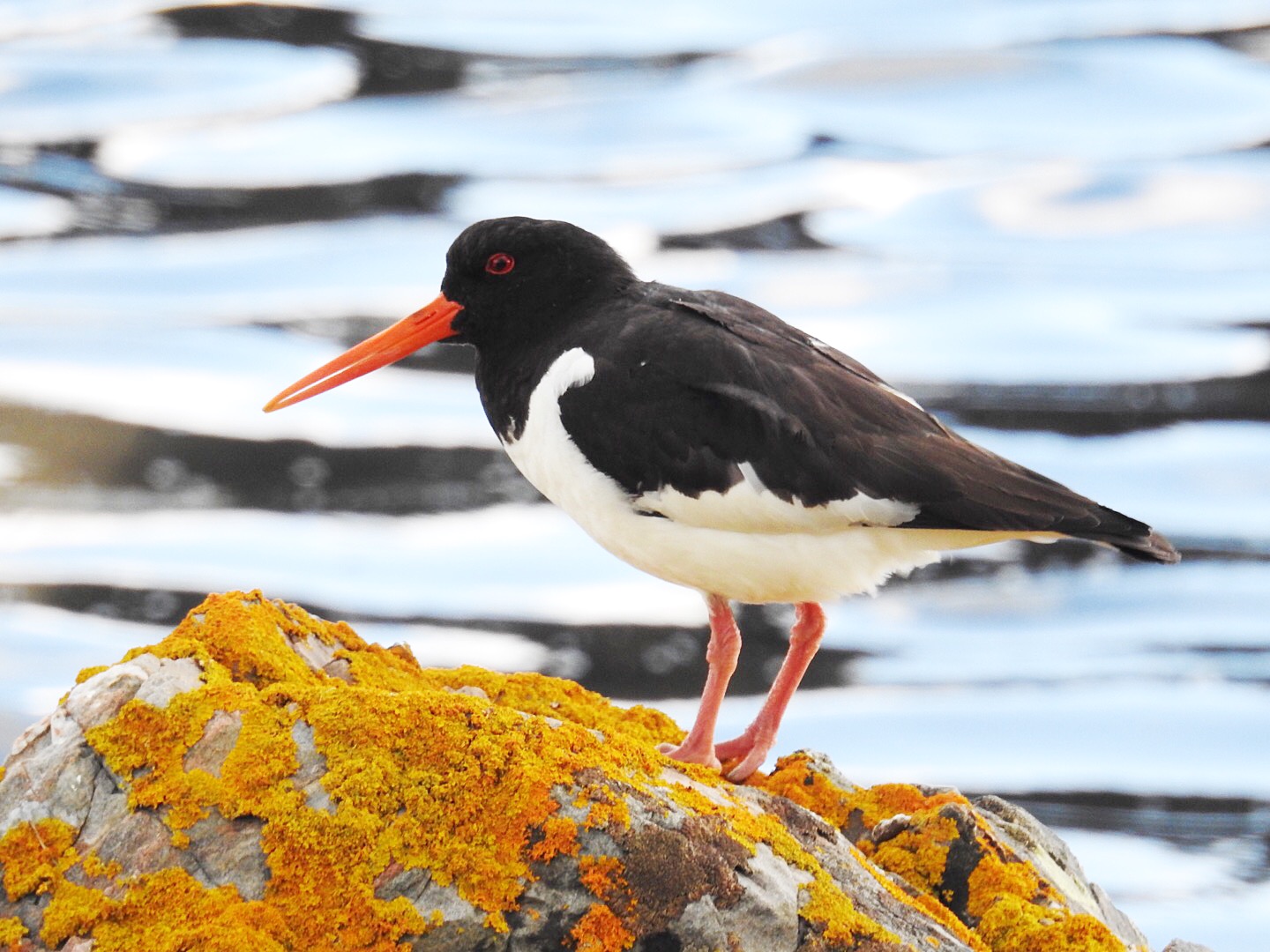
Loch Long is a tidal sea loch brimming with Grey Heron, Oystercatcher, Common Sandpiper and Curlew. The fields on either side of the cottage were full of Meadow Pipits and a small flock of Twite routinely gathered on the telephone wires between us and our neighbours though they proved too flighty to photograph.

Meadow Pipit, Loch Long

Meadow Pipit

Oystercatcher,  Loch Long.

The mountain valley beyond the end of the Loch is also home to 1-2 pairs of Golden Eagles. Unfortunately I never got to grips with them there.  My best chance would be on Skye.

Skye is somewhere we'd always wanted to visit so we decided that's where we'd head on day two of our stay. The South of the Island is dominated by the Cuillin Mountains, which rise to heights of over 900 m! The road north of the town of Broadford meanders around several sea lochs that cut into the coastal fringes. These are home to good sized flocks of Common Eider. Loch Ainort contained over sixty right by the road.

Loch Ainort, Skye.

Eider, one of over 60 on Loch Ainort.
Eider, Loch Ainort

We were heading for Dunvegan Castle over on the west side of the Island.  I'd been told that both Golden and White-tailed eagles had been seen from here. Today though, only a few harbour seals, Spotted Flycatchers and a showy Song Thrush.

Song Thrush, Dunvegan Castle. 

We were close to the northwest coast of Skye and decided to drive the road towards Loch Pooltiel and the Neist Point Lighthouse. This yielded a smart male Pied Flycatcher and a Twite but still no eagles. We looped back and stopped where the Hamra River empties into Loch Pooltiel and found my first Scotch Argus of the trip. Being overcast it settled in the grass and wouldn't show properly.

Scotch Argus - never settled in the open.
Hooded Crows are a common sight all around the west coast of Scotland and often sit perfectly for a photograph.

Hooded Crows, western Skye.
Just before we left I scanned the mountain ridges to our north one last time and immediately picked up a White-tailed Eagle as it dropped over the ridge and flew parallel to us about half-a-mile away. As it did so it was joined by two others and they soared briefly before vanishing over the ridges once more. This was pushing the Nikon P900 to its limit but you can still make out what they are.

White-tailed Eagle, Loch Pooltiel

White-tailed Eagle, Loch Pooltiel

Then it was back to Broadford and the wonderful Cafe Sia for brilliant homemade pizzas and coffee for dinner. 

Dinner!

What a great way to finish our first trip onto Skye.

Sunday, 22 July 2018

Creatures of the night...

Back in the 1980's, my brother Duncan, our mate Rich Heddington, and myself were busy running regular moth traps from our family home in Chard. We caught and identified a large number of species over the years using a very powerful mercury vapour light trap borrowed from our secondary school.  It pulled hundreds of moths on a good night with the added advantage that we always had a good tan! Thirty eight years later and I'm still looking at moths.  This time courtesy of my friend Nigel Marven, who owns a twin actinic Skinner trap.

Last night we took the kids to stay in Nigel's family home on the east Devon coast, a prime opportunity to run the trap and my bat detector somewhere different.

Both provided good results with nine species of bat, including Leisler's, Lesser Horseshoe and a Barbastelle. The moth trap yielded 23 species of moths.

Beautiful location to run the moth trap.

Ruby Tiger - half-a-dozen of these
beauties in the trap.

Leopard Moth

Buff Arches

Pebble Prominent


Sallow Kitten

Nut-tree Tussock
Jake enjoying a book by head torch.


Pale Prominent

Flame Shoulder

Oak Eggar,  female

Black Arches
A stroll this morning produced good numbers of Comma butterflies along the local lanes with a single Painted Lady, six Holly Blues and four Wood Whites.

Pair of Wood Whites

Holly Blue


Thursday, 5 July 2018

Oh Canada...

I’m very lucky. My job frequently takes me off to one of the World’s most desirable tourist destinations, Canada. I’ve just got back from a whirlwind visit to the eastern Provinces leading a group from Montreal to Quebec City, through to New Brunswick, on to Nova Scotia and finishing in Newfoundland...all in a week!

Whilst work always comes first, there’s no way I can avoid birding on my travels and this trip was no exception. Without trying at all I managed to see 40+ species in the cities we visited. All common species but always good to see.

Hopewell Rocks situated in the Bay of Fundy in New Brunswick is home to the highest tides in the world. They fall and rise up to 52 ft each day and you can walk on the ocean floor as the tide recedes. It was also good for a few species including a stonking male Parula Warbler.

At high tide the water laps around the base of the vegetation
on top of the rockes in this picture.

American Goldfinch, male. Very common everywhere: R. Harris

Dark-eyed (Slate-colored) Junco at Hopewell Rocks, NB
American Robin, Hopewell Rocks, NB

The ubiquitous Song Sparrow, one of the commonest
species to be seen and heard in eastern Canada.

Northern Parula, male at Hopewell Rocks: R. Harris

Chipping Sparrow, Saint John, NB
St Andrews by-the-sea is another very pretty little town with colonial style detached houses, big lawns and lots of American Robins. There must have been in excess of 15 on the one short street that I walked.
American Robins, St Andrews by-the-sea, NB

American Robin, juvenile 

Common Grackle, St Andrews, NB
St Andrews is also great for whale watching as it lies on the Bay of Fundy. A two hour zodiac trip produced mostly Minke Whales along with a possible Fin, lots of harbour porpoise and some distant dolphins.

This town is whale crazy!

St Andrews, New Brunswick
Heavily cropped Minke Whale, Bay of Fundy
Harbour Porpoise
Harbour Porpoise

Then it was on to the Algonquin Resort, one of the top properties in the region and surrounded by leafy suburbs and a few more birds including American Redstart, Mourning Dove, Chimney Swift, Tree Swallow, and a few sparrow species...

The Algonquin Resort, St Andrews by-the-sea, NB
Another Song Sparrow, they're everywhere. 

American Redstart, male. Easier to hear than to see sometimes.
A bit of pishing brought this one out briefly. 

American Redstart, male.
After New Brunswick we boarded 'The Ocean' a VIA Rail service linking Moncton, NB to Halifax Nova Scotia. Our first trip out was to see the iconic Peggy's Cove and its famous lighthouse.

Peggy's Cove, NS

The Lighthouse at Peggy's Cove.
If you'd been standing here on 2 September 1998
you would have witnessed the final moments of
Swiss Air 111 as it crashed into the sea killing all 229 passengers and crew

I noticed a small, long-tailed warbler flitting around the scrub and with a bit of pishing, out it popped - a young male Yellowthroat not 8 ft away.

Yellowthroat, young male - Peggy's Cove, NS

If that wasn't enough my pishing soon attracted this stunning male Yellow Warbler too.

Yellow Warbler, male - Peggy's Cove,  NS

Yellow Warbler, male - Peggy's Cove,  NS

Followed almost immediately by this Gray Catbird - pishing works so well in North America!

Gray Catbird, Peggy's Cove,  NS
Aside from birds the local Pitcher Plants were in full bloom too. These brightly coloured plants are insectivorous,  luring flies and other insects into the pitchers at the flower base. Here they drown in the fluid filled cups and the plants absorb the resulting mineral soup.

Pitcher Plant, Peggy's Cove, NS

The pitcher, where insects meet their demise. 

We finished our tour with a seven hour stop at St John's, Newfoundland. Enough time to have a city tour, a side trip to Cape Spear, a brewery tour at Quidi Vidi and dinner before catching our Air Canada flight home.

Quidi Vidi, St John's, Newfoundland

Quidi Vidi produced the usual gull species,  Black Duck, Dark-eyed Junco and this obliging Common Tern.

Common Tern, Quidi Vidi, NF


What a fantastic trip. Canada never disappoints and I can't wait for my next visit.